

Common security solutions for office building gates include sliding and rolling steel gates, intercom systems, keycards, and biometric authentication. The best options for your office building depend on the specific security challenges you face, gate traffic, and your budget.
In this guide, we discuss how common office building gate security solutions work to minimize security threats. We also discuss how to choose the best ones for your office building.
A-24 Hour Door National Inc. provides a wide range of office building security solutions. We specialize in commercial security door services in Philadelphia. Call (215) 654-9550 to learn more about your office building gate options.
Common Gate Security Systems for Office Buildings
Common office building gate security solutions include automated sliding gates and intercom systems. The right solution depends on your building, the traffic volume, and possible threats.
Here is a breakdown of the most effective systems available for commercial office facilities.
Automated Slide Gates
Automated slide gates operate on a horizontal track system powered by an electric motor. A remote access controller opens and closes them in response to access credentials or remote commands.
Sliding gates provide wide vehicle access without a swing, making them ideal for parking lots and loading areas with limited space. They directly control vehicle and pedestrian access at the perimeter and prevent unauthorized entry.
For office building owners, sliding gates are a durable, low-maintenance perimeter solution with long lifespans. They integrate with keycard readers, RFID systems, intercom stations, and license plate recognition cameras.
Special Security Gates like Swing Gates
Some office buildings require access gates engineered to meet specific security requirements. The following specialized gate types are commonly used in commercial office settings.
Swing Gates and Barrier Arms
Swing gates operate on a pivot mechanism, opening inward or outward to control access. Barrier arms or boom gates use a horizontal arm that raises and lowers to regulate vehicle flow at entry and exit points. Barrier arms are often used at parking lots and loading dock access points. They integrate with access control and LPR systems for automated vehicle authentication.
Rolling Steel Security Gates
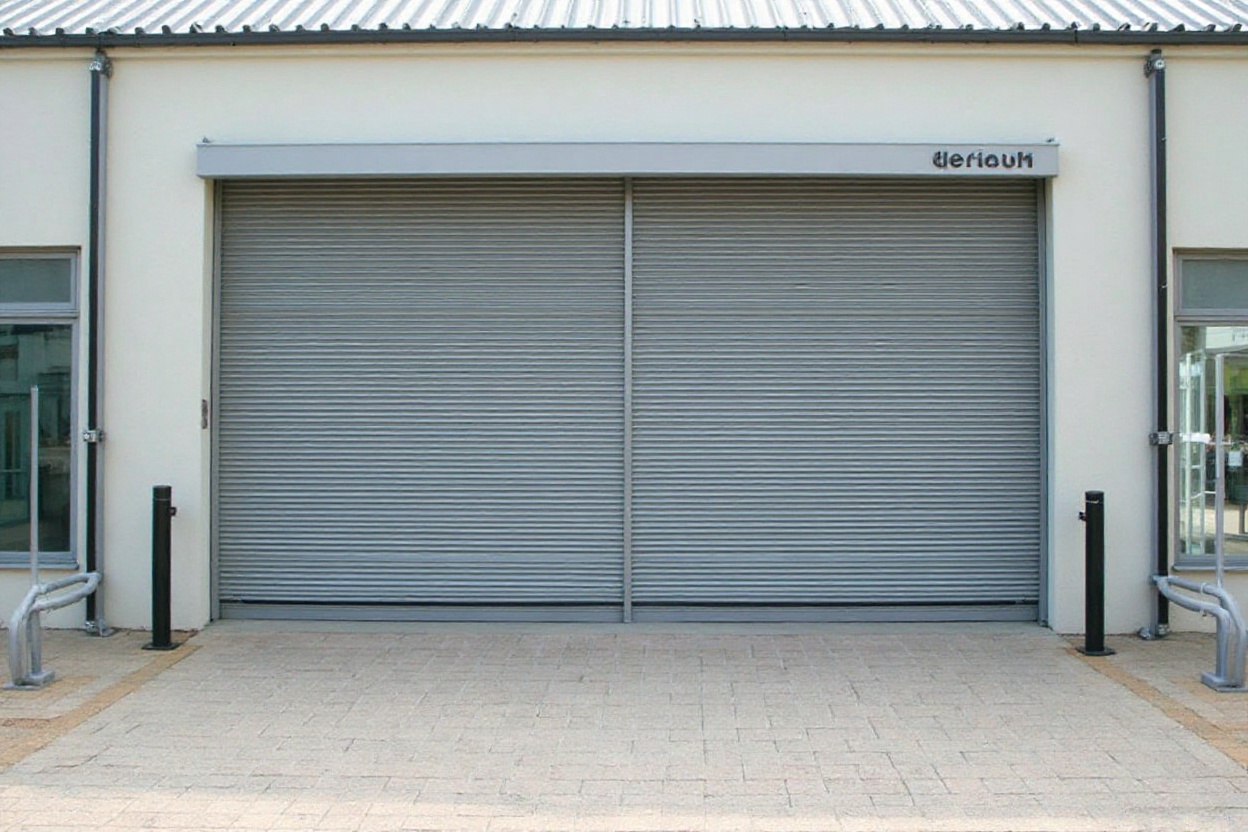
Rolling steel security gates retract vertically into a compact coil above the opening, preserving clearance height. They have an interlocking steel-slat construction that provides strong resistance to forced entry and impact. They are particularly effective for after-hours perimeter protection when a facility is unoccupied.
Scissor Gates for Interior Zones
Scissor gates are automatic, collapsible steel lattice barriers. They are used to secure interior access points in office buildings, including elevator or lift lobbies, mailrooms, server rooms, and service corridors. They fold away completely during business hours and reopen after working hours. Their open lattice design maintains visibility while physically restricting unauthorized movement between zones.
Security Turnstiles and Speed Gates
Turnstiles and speed gates control pedestrian access at building lobbies, reception areas, and secure floor entries. Full-height turnstiles provide the strongest physical barrier, while waist-height turnstiles and speed gates balance security with high pedestrian flow. They integrate with keycard, RFID, and biometric systems to allow only verified individuals through.
Keycard and RFID Access Control Systems
Proximity keycards and RFID access control systems communicate wirelessly with mounted readers to grant or deny access based on stored credentials. Permissions are managed centrally, with administrators adding, modifying, or revoking access.
Every event is logged with a timestamp, creating a complete audit trail for reviews and reporting in management software. Multi-door systems support multiple access levels across zones, restricting sensitive areas to authorized personnel only.
For security gate office buildings, keycard and RFID systems eliminate the need for physical key management. This reduces lockout incidents and provides accountability for every access event at an entry gate.
Biometric Authentication Systems
Biometric authentication systems verify identity using unique physical characteristics, most commonly fingerprints. It also uses facial geometry and iris patterns.
Unlike keycards or PINs, biometric credentials cannot be shared, lost, or stolen. This makes them one of the highest-assurance security measures for office access control.
Fingerprint readers are cost-effective and widely deployed at individual gate entry points. Facial recognition systems offer touchless authentication. Multi-factor authentication combines biometrics with a PIN or keycard for maximum security in sensitive areas.
For office building managers, biometric systems eliminate credential sharing and enhance accountability.
License Plate Recognition (LPR) Systems
License plate recognition systems use high-resolution security cameras and OCR software to identify vehicles by their registration plates. When a recognized plate approaches a gate, the system automatically opens the gate. Unrecognized plates are flagged for review or denied entry.
LPR systems log every vehicle entry and exit with a timestamp and image data. They are widely deployed at office building parking structures, loading dock gates, and executive parking areas. For facility managers, LPR systems eliminate the need for vehicle access passes, reduce queuing at entry points, and provide detailed records of vehicle movements.
Intercom and Video Verification Systems
Intercom and video verification systems enable security personnel to remotely screen and verify visitor identities before granting gate access. IP-based video intercom stations at gate entry points transmit live audio and high-definition video to a security desk or mobile device. The operator verifies the visitor’s identity and then remotely opens the gate.
Two-way audio communication allows direct conversation without physical proximity. Modern systems integrate with access control platforms, logging every interaction with a timestamp and video capture.
For office buildings with high visitor volumes, video verification systems reduce unauthorized entry, support front-desk staffing efficiency, and create documented visitor records. They are useful at main entrances where daily visitor management is required.
CCTV and Alarm Integration
CCTV positioned at gate entry and exit points provides continuous visual monitoring, real-time alerts, and timestamped video evidence. Sensors trigger alarms when barriers are forced or tampered with outside authorized access events. Motion-activated lighting responds to after-hours activity, which stops intruders and improves camera image quality. Alarms notify on-site security or remote monitoring centers via management software.
For office building operators, CCTV and alarm integration transforms individual access gates into a fully connected security system. It directly supports incident investigation and insurance compliance.
How to Choose the Right Gate Security Solution for Your Office Building
To choose the right office gate access control system and security solution, start by assessing your building’s specific vulnerabilities, traffic volume, and operational requirements.
High-traffic lobbies and parking entrances need solutions that balance traffic with access control. Consider speed gates, barrier arms, and LPR access systems. Facilities that store sensitive data or high-value assets require layered security that combines biometric authentication, special gates, and integrated alarms.
Always verify that a chosen solution complies with ADA accessibility requirements, local fire egress codes, and applicable ANSI/BHMA commercial standards.
Why Office Building Gate Security Matters
Office building gate security controls who enter, logs every access event, and deters threats before they reach your building’s interior. For facility managers and building owners, a well-designed gate security system demonstrates a duty of care to staff and directly reduces insurance exposure and regulatory liability.
Office buildings are high-value targets. They house sensitive data, expensive equipment, and large numbers of employees and visitors daily. Without controlled perimeter access, unauthorized individuals can enter freely, creating workplace safety risks.
Secure Your Office Building with the Right Contractor
A-24 Hour Door National Inc. installs, repairs, and maintains a full range of commercial office security systems. From automated sliding doors to rolling steel doors, we handle every required step. Our AAADM-certified technicians follow manufacturer specifications on every installation. We are also available 24 hours a day, 7 days a week, to resolve emergencies.
Call (215) 654-9550 for commercial security door installation services near you.
Frequently Asked Questions
What is the most effective gate security solution for a commercial office building?
There is no single most effective solution. A layered approach that combines automated gates, electronic access control, CCTV, and alarm integration provides the strongest protection. The right combination depends on your office building’s traffic volume, threat profile, and budget.
How often should commercial office gate systems be serviced?
Commercial security gate systems should be professionally inspected at least once every year. High-traffic facilities benefit from quarterly servicing. Regular maintenance catches worn operators, misaligned tracks, and sensor faults before they create security gaps or cause costly emergency repairs.
Do commercial gate systems need to comply with ADA requirements?
Yes. Pedestrian gate access points in commercial buildings must comply with ADA accessibility guidelines. These include accessible hardware height, clear opening width, and low-force operation. Automated security gate systems must also meet applicable ANSI/BHMA safety standards.